Post-Trade Analysis: How I Review My Trades

Ross
Ross is a co-founder of TraderLion and Deepvue. He was mentored by William O’Neil, and co-authored The Model Book of Greatest Stock Market Winners at WON + Co.
Published: October 21, 2026


 Ross Haber
Every new post, straight to your inbox
If this was useful, the next one will land in your inbox the day I write it.
What Is Post-Trade Analysis?
Early on, I treated every closed trade as finished business. A winner felt good, a loser stung, and either way I moved on to the next chart. I didn’t look back at the trade itself. So I kept making the same mistakes and calling them bad luck.
Post-trade analysis changed that. It is not the same thing as a model book. A model book studies the stock: where it should have been bought and sold by the rules. Post-analysis studies you: where you actually bought and sold, and why the two don’t match. You need both. This post is about the second one.
Why Post-Trade Analysis Matters
Bill O’Neil created many of his rules this way. Early in his career, he went back through every trade he made, winners and losers, and looked for what he did right and wrong. He found it wasn’t necessarily about stock picking. It was about rules and risk management. For example, you might realize that he held some losers too long and sold some of his biggest winners too early. The rules he wrote afterward came out of his own mistakes.
Athletes watch film. They don’t only watch the highlights. They watch the plays that went wrong, slowly, until they can see the moment it broke down. Your trades are your film. Without reviewing them, you are relying on memory, and memory is generous to winners and quick to forget the rule(s) you broke on a loser.
It also keeps risk management honest. You can say you cut losses at 7%. Your trade log tells you whether you did.
The part most people skip: reviewing the “small” winners. A winner where you sold at the first sign of profit and missed the real move is a mistake too. It just doesn’t hurt, so nobody looks at it.
How I Review My Trades
I pull up a daily chart for each trade and mark my actual buy and sell points. Then I put the rules next to it and ask where they disagree.
What I mark on every trade
- The entry. My fill against the proper pivot. Was it a sound entry point, or was it already 6% or 8% extended when I bought?
- The setup. A launchpad, a consolidation pivot, a breakout? Over enough trades, you find out which setups actually pay you.
- The entry tactic. Was I buying weakness on a pullback or an undercut, or buying strength as the stock cleared resistance? Track it alongside the setup. Over time, you’ll see which tactic is working for you right now, and on which setups.
- The exit. Did I sell on a rule, like the second consecutive close below the 21-day SMA, or on a feeling?
- The size. Was the position the size I planned, or did I add because I was excited?
- The market. Where was the general market when I bought? Was there a follow-through day behind me, or was I buying into a correction?
- Leadership confirmation. Was it a leading stock in a leading group, early in its cycle, confirmed by other institutional-quality leaders in the same group?
What I compare it against
The rules, not the outcome. A trade that made money while breaking three rules is a bad trade that got lucky. A trade that followed every rule and got stopped out for a small loss is a good trade. If you grade on profit alone, you reinforce the habits that will hurt you later.
What it looks like when it fails
Post-analysis goes wrong in two ways. The first is reviewing too few trades. Three trades is a story, not a pattern. Wait until you have twenty or more before you change a rule. The second is turning the review into punishment. The point is not to feel bad about the trade. The point is to find the one thing you’ll do differently. If you finish a session without a written change, you reviewed, but you didn’t analyze.
Three Mistakes the Review Catches
These three patterns show up most often when I review trades, mine and other traders’. Each chart has the actual buy and sell marked against where the rules said they should have been.
Buying extended
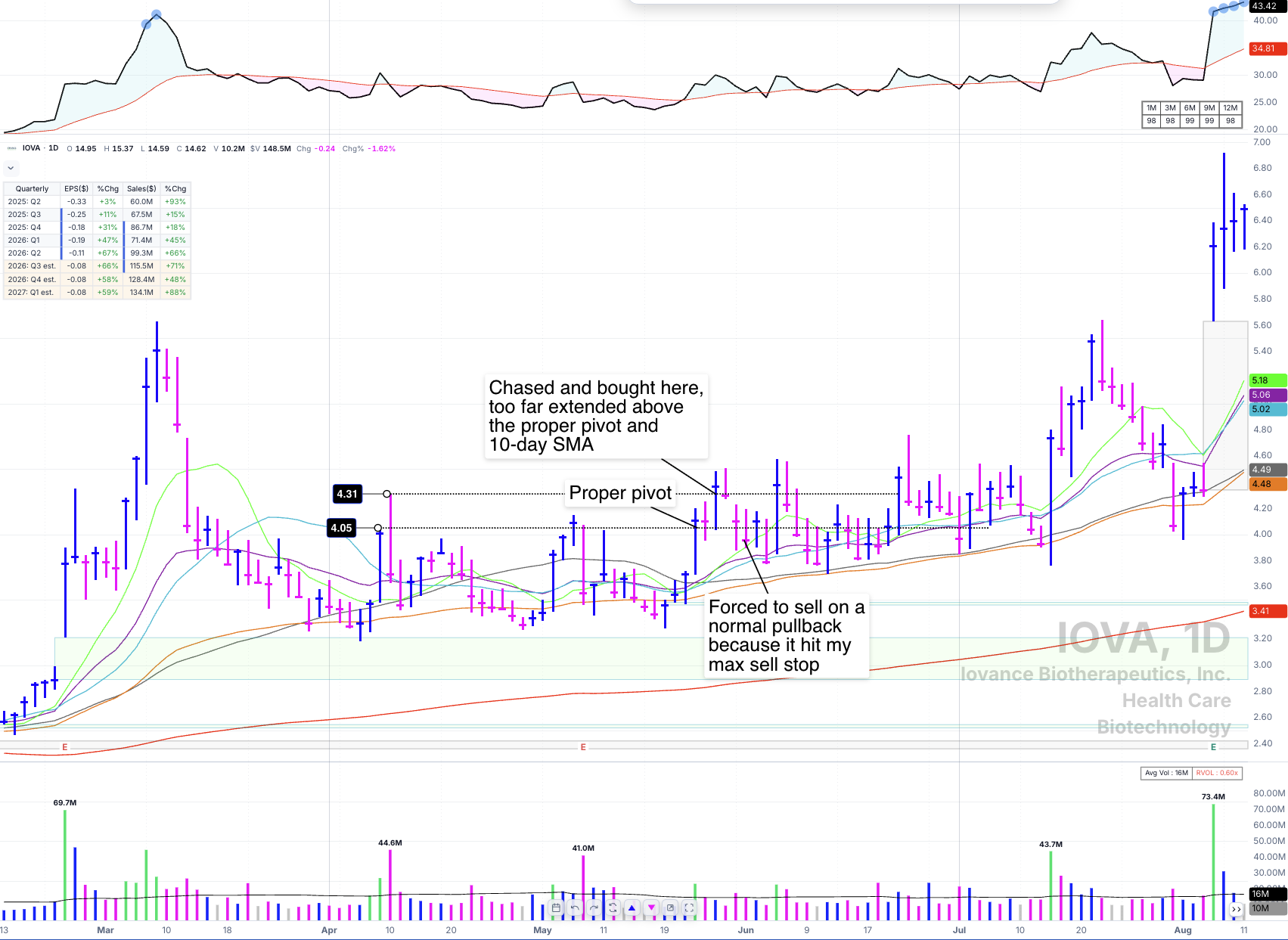
The proper pivot was here. I bought up there. The normal pullback took me out.
The stock was right. The entry wasn’t. Buying 6% or 8% above the pivot means a normal pullback hits your stop before the move even starts. When the review shows a cluster of these, the fix is not a different stock list. It’s waiting for the setup, or using an early entry closer to the launchpad.
Selling too early (SNDK)
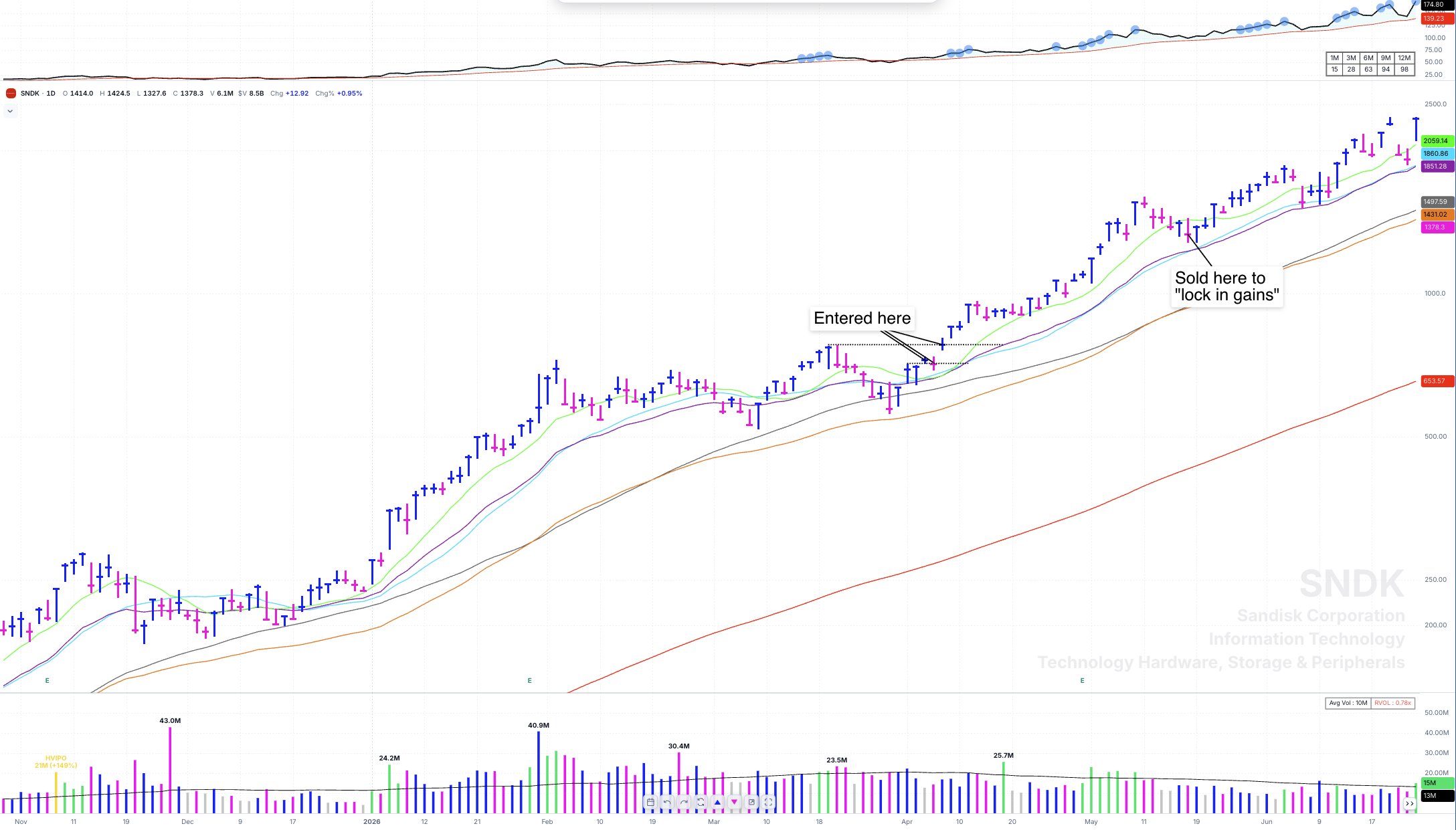
Sold on the first shakeout below the 10-day SMA. The 21-day SMA never broke. The real move came after I was out.
This one doesn’t show up in your losses, so review it. You took a premature gain on the first shakeout, and the stock went on without you. If the sell rule never triggered, the sale was a feeling. Mark where the rule would have had you sell, and measure the gap.
Holding a loser past the stop
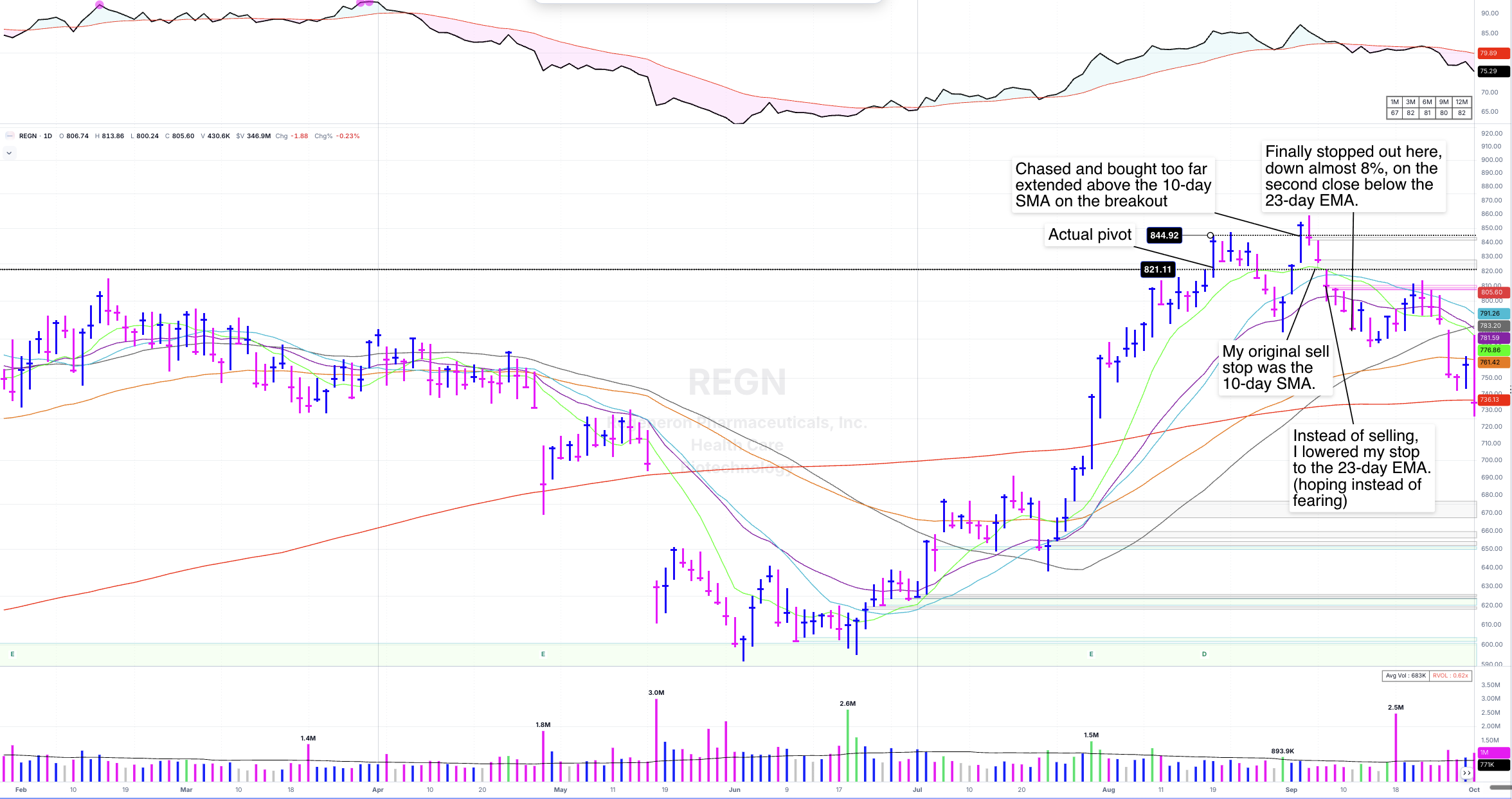
The stop was at -2.8%. I sold at -7.5%, because I was sure it would bouce.
The most expensive of the three patterns. The stop would have cost me 2.8%. Holding on cost me 7.5%, and it took about 8.1% to get back to even. Every time you move the stop, you turn a small, planned loss into a large, unplanned one. If the review finds even two of these, the stop is the first rule to fix.
How to Start Post-Analysis This Week
- Pull your last 20 closed trades. Winners and losers. If you have fewer, use what you have, and don’t change any rules yet.
- Mark each one on a daily chart: your buy, your sell, the proper pivot, and where your sell rule would have triggered. Deepvue makes this quick if you keep your charts there.
- Put each trade in a simple table: setup, entry tactic, entry distance from pivot, exit reason, size, market condition, result.
- Sort the table and look for the repeat. Most traders find one mistake that accounts for most of the damage.
- Write down one rule change. One. Trade it for the next 20 trades, then review again.
You don’t need to do this every day. Once a month or once a quarter is enough, as long as you actually do it. Consistency is the key. Don’t worry about what anyone else’s review looks like. You know your own trades best.
The TML Report
Twice a week, I publish where I think we stand: the market overview, the four index charts, and a focus list with the lines already drawn on them. It’s a useful reference point when you review: what did the market look like the week you made that trade?