
Does Buying Breakouts Still Work?

Ross
Ross is a co-founder of TraderLion and Deepvue. He was mentored by William O’Neil, and co-authored The Model Book of Greatest Stock Market Winners at WON + Co.
Published: August 15, 2026


In the late ’90s, when I was buying breakouts the classic way, things moved in a more organized, methodical manner, and market structure was much simpler. The big brokers — Goldman Sachs, Morgan Stanley, Merrill Lynch, etc. — sat at the top of Level 2, the only ECN was Instinet, and stocks still traded in fractions. For the most part, live people were behind all of the trades that happened, not machines.
Fast forward 30 years, and the market structure and environment are a completely different story:
- SOES (Small Order Execution System) trading led to ECNs galore, i.e. ARCA, BATS, EDGX, etc.
- Stocks began trading in decimals instead of fractions. So now stocks trade in fractions of pennies rather than fractions of dollars.
- Algorithmic orders became increasingly commonplace as large algorithmic and high-frequency traders entered the picture.
- Add AI to the picture, and now the market operates in a much faster, more volatile manner than it did in the mid to late 1990s.
On a relative basis, the market now operates at warp speed. What worked well in the late ’90s no longer works as well in today’s environment. It’s not that it doesn’t work at all. It’s just that the consistency with which it worked decreased notably. I wrote about where those original rules came from in 10 Lessons I Learned From Working With William O’Neil — this piece is about what I changed after.
Ross Haber
Every new post, straight to your inbox
If this was useful, the next one will land in your inbox the day I write it.
Why Buying Breakouts Got Harder
Some markets are more cooperative than others for any given methodology. Sometimes the market environment is extremely cooperative. Those are the times when you feel like you’re a genius and can do no wrong.
Conversely, there are other times when it feels like no matter what you do, you can’t get anything right.
The trap is blaming yourself, or blaming the method, when what actually changed is the environment the method runs in. Speed and volatility have increased significantly over the last few decades. A breakout that used to follow through cleanly now gets shaken out, retested, and shaken out again before it goes — if it goes. The obvious entry is the crowded entry, and the machines see it too. That’s why I lean on relative strength and evidence of quiet institutional accumulation before I care about the pivot at all.
I have also learned that different stocks have distinct personalities, which is important to understand because it affects which entry tactics to employ to manage risk efficiently and effectively. The bottom line is that speed and volatility have increased, so I’ve adapted my rule set accordingly — including borrowing from Stan Weinstein’s stage analysis, which I’ll get to below.
What I Changed: How I Buy Breakouts Now
Now let’s discuss some specifics of what I actually changed to address how the market currently operates versus how it used to. Five adjustments.
1. Stick to stocks with the right personality
I stick to stocks with specific personalities based on my methodology, risk tolerance, and how my brain works. Tight and organized suits me; wide and loose does not. A wide-and-loose name can be a great stock and still be a bad stock for me, because its normal noise blows through my stops. Know which one you’re looking at before you decide how to enter — a volatility contraction pattern is one I look for that tells me a name is getting tight.
2. Buy strength only in certain situations
I now only buy strength in certain situations. The classic breakout — buying the high-volume move through the pivot — hasn’t been retired, but it’s no longer my default. It has to be the right stock, in the right environment, out of the right structure, like a proper flat base. When those line up, I’ll still take it.
3. Buy constructive weakness at key support
I prefer to buy constructive weakness within an overall uptrend at key support. Weakness is constructive when the pullback is orderly, volume dries up on the way down, and the stock holds where it should — a rising moving average or a prior pivot. That entry puts my stop close and puts the burden of proof on the stock, not on my patience.
4. Start early at consolidation pivots — my “Stan SLIM” stocks
I start buying early up the right side at what I call consolidation pivots, based on what I’ve learned from Stan Weinstein’s methodology. I refer to these as my Stan SLIM stocks. Instead of waiting for the whole base to complete and paying up at or near the old high with everyone else, I’m building the position inside the structure, at pivots the crowd isn’t watching. The risk point is defined by the consolidation itself, so the entry is earlier and the stop is tighter. It’s the same idea behind the launchpad early entry — get positioned before the obvious moment, not during it.
5. Run smaller size
I have reduced my overall position size. In a faster, more volatile market, the same conviction gets expressed in fewer shares. Smaller size means a shakeout is an annoyance instead of a decision, and it keeps me from getting knocked out of a good stock by noise. Size is a risk management decision made before the entry, never after.
What it looks like when I’m wrong
Every one of these entries comes with a named invalidation. If I buy a consolidation pivot and the stock breaks back down through the structure I bought it from, the reason for the trade is gone and so am I. And once a stock is extended and trending, my longstanding rule still governs the exit: a second close below the 21-day SMA, and I’m selling at least a third to half. If you don’t know exactly where you’re wrong before you enter, you don’t have a trade.
Three Charts That Show the Difference
Now let’s take a look at some stock charts as examples.
FSLY — Fastly, Inc., 2026
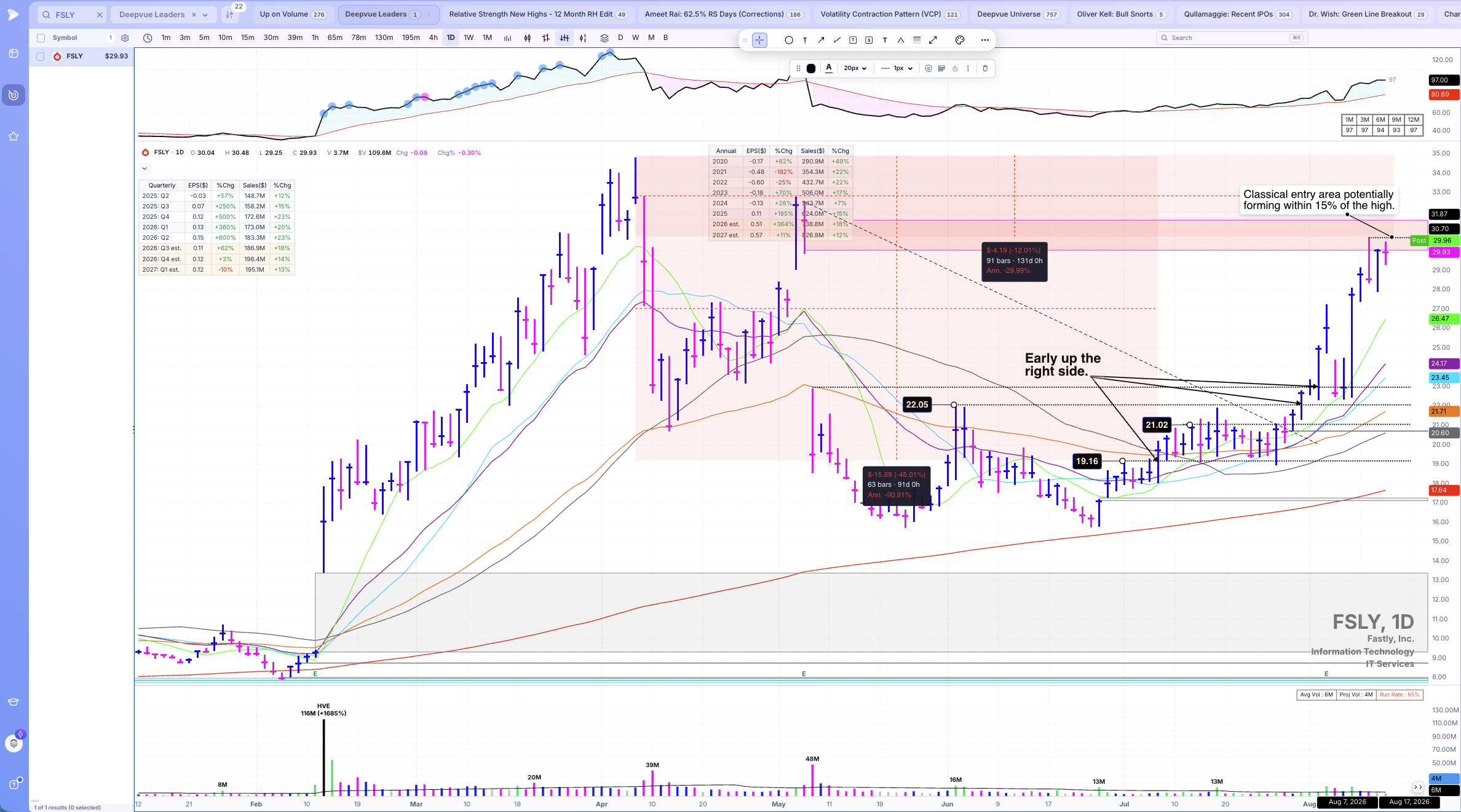
Early up the right side, ‘Stan SLIM’ style.
The difference between entering early up the right side in the lower half of the base versus the textbook entry area makes all the difference, especially when it comes to managing risk. Note how the first early entry area is 45% off the prior high, whereas the textbook entry area is 12% to 15% off the prior high. Entering early gives you more than a 30% head start. Also, you tend to avoid the breakout crowd looking for those textbook traditional breakouts within 15% of a stock’s prior high.
AXTI — AXT, Inc., 2026
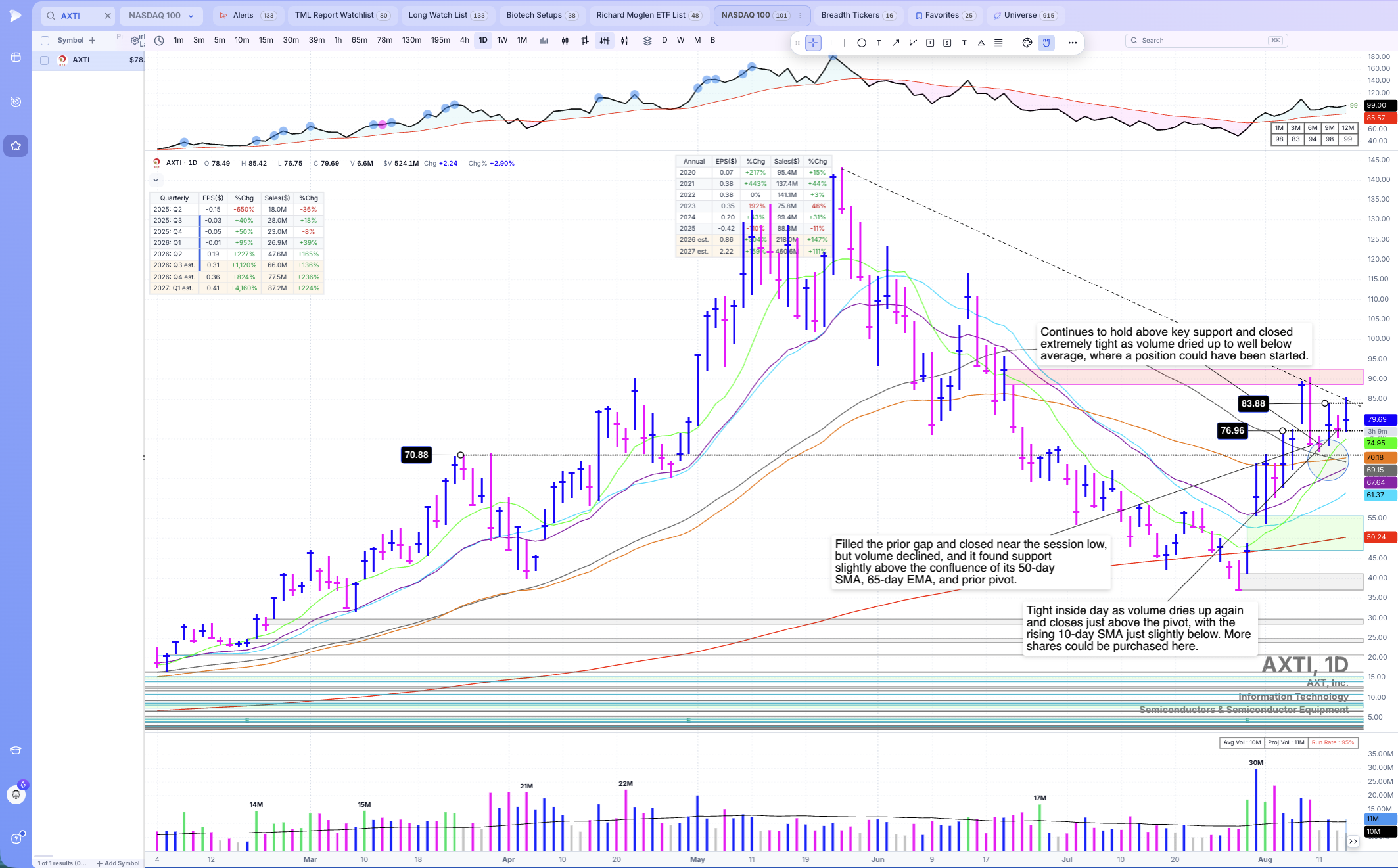
Tight, constructive action at key support.
The ideal ‘constructive-weakness entry’ should have an orderly pullback, volume dry-up, and support that holds.
ALMS — Alumis Inc., 2026
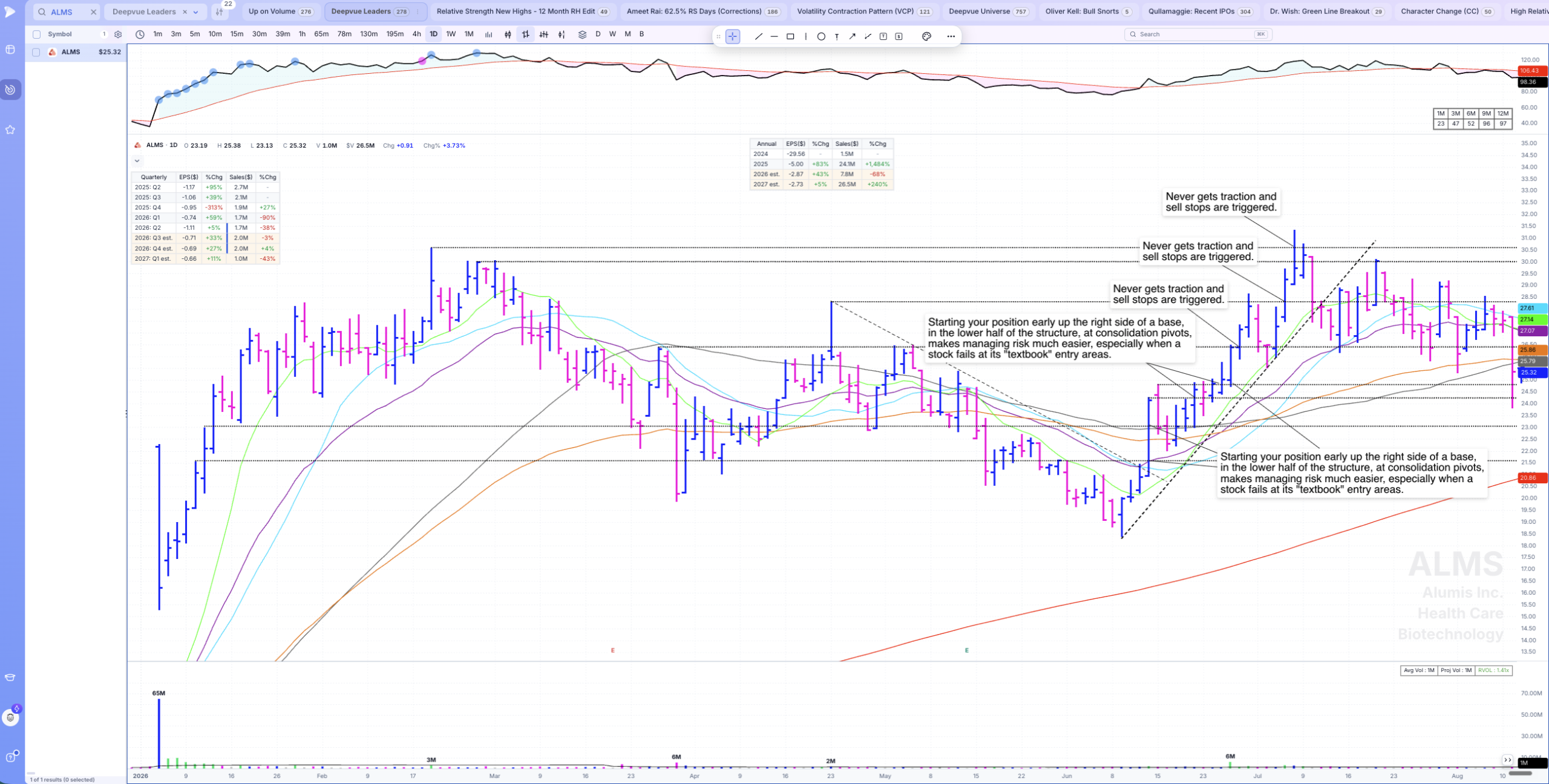
Initiating a position early at consolidation pivots makes managing risk significantly easier.
This ALMS chart clearly shows the benefits of entering a stock in the lower half of its base before the textbook entry areas even begin to appear.
What to Do This Week
- Review your last five breakout buys. For each one, write down whether the entry was the classic pivot or something earlier, and how far the stock pulled against you before resolving.
- Go through your current watchlist and label each name’s personality: tight and organized, or wide and loose. Drop the ones that don’t fit the way your brain works.
- Run a screen for names building the right side of a consolidation, and mark the consolidation pivots on each chart before the old high is anywhere in play.
- Pick five charts and mark two entries on each: the classic breakout and the earlier pivot. Measure the distance to a logical stop from both. That difference is the whole argument of this piece.
- Decide your size and your invalidation before the entry — the moving average sell rules handle the back end, but only if the front end was planned.
This Is How I Cover Stocks in The TML Report
Twice a week I publish the market overview, the indexes, and a focus list of True Market Leaders — marked-up charts, consolidation pivots and all, one to two sentences per name.
See The TML Report