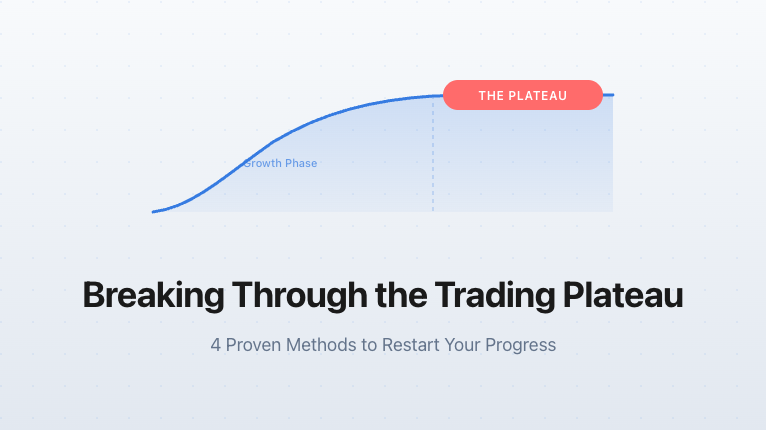
Stuck in a Trading Rut? 4 Proven Methods to Break Through
Published: November 28, 2025


You’ve been improving steadily for months. Your win rate climbs, your losses shrink, and your confidence grows. Then suddenly, everything stalls. Welcome to the trading plateau—the most psychologically challenging phase of any performance journey.
The plateau effect: when progress stalls despite continued effort
The Inevitable Wall
Just like every athlete hits walls where progress stops despite continued effort, traders experience identical stock trading plateaus—periods where skills stagnate and results flat-line. Understanding why plateaus happen and how to break through them separates those who quit from those who reach elite levels.
Why Plateaus Happen: The Science of Adaptation
Both athletic performance and trading skill follow the same biological and psychological adaptation patterns. Initial learning produces rapid gains because everything is a new stimulus. Eventually, your nervous system adapts completely to current demands, and without new challenges, growth stops.
A runner drops their 5K time from 30 minutes to 25 minutes in six months of consistent training. Then progress stops. They run the same routes, same pace, same distance. Their body has adapted completely—cardiovascular system, muscles, energy systems all optimized for current demand. Without new stress, there’s no stimulus for further adaptation.
A trader masters one setup and achieves consistent profitability. Then returns stagnate. They see the same patterns, execute the same rules, and manage risk identically. Their pattern recognition and execution have plateaued. No new challenges mean no new neural pathway development.
The Psychology of Plateau Frustration
Plateaus are mentally brutal because effort continues, but results don’t. An athlete training hard without improvement questions their talent, while a trader executing flawlessly without profit growth questions their potential. Both face the same psychological trap: interpreting adaptation as limitation.
Common Plateau Psychology Traps
- Early gains create unrealistic expectations of linear progress
- Plateaus challenge identity (“maybe I’m not good enough”)
- Frustration leads to either overtraining or giving up entirely
- The path through requires patience that most performers lack
The Adaptation Cycle in Stock Trading
Understanding the adaptation cycle helps normalize trading plateaus as necessary phases rather than failures. Performance improvement through trading psychology follows a predictable pattern: stimulus, adaptation, plateau, new stimulus.
The Four Phases of Adaptation
Why Most Performances Stall
The plateau phase feels wrong because earlier phases felt progressive. Athletes and traders alike misinterpret the plateau as evidence they’ve reached their limit. In reality, they’ve simply exhausted adaptation potential from the current stimulus and need strategic change to restart the cycle.
Critical Insight: Plateaus aren’t walls to break through with harder effort. They’re signals requiring smarter stimulus.
An athlete running the same workout harder won’t break their plateau. A trader forcing more trades with their current strategy won’t either. Both need to change the stimulus, not increase intensity.
“Your body and brain are incredibly efficient adaptation machines. They optimize completely for whatever demands you place on them, then idle until new demands arise. Plateaus are signals of your previous system’s successes awaiting new challenges.”
Strategic Changes That Break Plateaus
Breaking through plateaus requires strategic modification, not motivational speeches or harder effort. Anyone with a trading plateau can use similar categories of change to restart the adaptation cycle and resume progress.
Variable Change
Modify training variables: change timeframes, add new setups, modify position sizing approach, trade different instruments, or adjust risk parameters. Fresh variables create fresh stimulus.
Skill Addition
Add complementary skills: a day trader adds swing trading, a technical analyst learns fundamental analysis, a discretionary trader explores systematic approaches. New skills force brain reorganization.
Important: When you make strategic changes, you’re not abandoning your system. Adding new approaches helps develop your stock trading skills. The core approach stays the same—you’re just discovering new angles, refining your execution, and deepening your understanding. Think of it as expanding your system, not replacing it.
The Periodization Principle
Top athletes don’t train the same way year-round. They rotate through different phases. Traders can do the same thing: mix up intense trading weeks with learning weeks, alternate between pushing hard and pulling back, switch between familiar setups and studying new patterns.
4 Methods to Break Through Your Trading Plateau
Beyond understanding plateaus intellectually, specific techniques accelerate breakthroughs for traders. These methods provide new stimulus while building on existing capabilities rather than abandoning what works.
The Constraint Technique
Add artificial constraints to force adaptation. Athletes train with resistance bands, reduced rest, or handicaps. Traders might limit themselves to smaller position sizes, fewer trades, or specific market conditions. Constraints force efficiency improvements that break plateaus.
The Scale-Back Approach
When runners hit a wall, they sometimes train longer distances to build capacity. Traders do the opposite. Cutting your position size in half or more removes the pressure that’s blocking your performance. You can focus on execution without the stress of big dollar swings. When your confidence returns and you’re executing cleanly again, scale back up. The plateau breaks because you fixed the mental side, not the mechanical side.
The Mentor Injection
An external perspective identifies blind spots you can’t see. Athletes hire coaches when progress stops. Traders join groups or hire mentors. Fresh eyes spot subtle execution errors or missing puzzle pieces that keep you stuck.
The Breakthrough Mindset
Perhaps most important is the mindset during trading plateau periods. Elite performers view plateaus not as walls but as information. What isn’t working? What needs to change? What am I avoiding that might unlock the next level?
The plateau isn’t punishment for inadequate effort. It’s feedback about inadequate variation. Respond to that feedback strategically, and breakthroughs follow. Ignore it and grind harder at the same approach, and you will burn out or quit instead.
Remember: Every accomplished athlete and trader has hit multiple plateaus. The ones who reached elite levels didn’t avoid plateaus—they developed systematic approaches for breaking through them. Plateaus are milestones marking the path to bigger successes.